
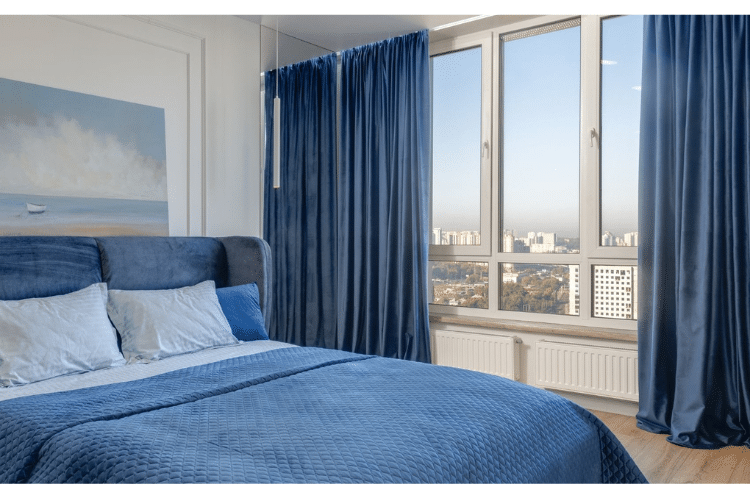
Draw a curtain to one side, then picture a blind lifting above the same window. Which leaves more of the view open? Furniture, handles and the way you move through the room often settle the choice before colour does. See also curtains guide.
Picture a normal day
Consider a living room with a sliding door to the patio. The covering needs to handle privacy and glare, but people also need to walk through that opening. A blind that must be raised before the door can be used may suit a door opened occasionally. Curtains that stack clear of the doorway may be easier for frequent access, if there is enough wall space beside the opening and the furniture does not obstruct the fabric.
For a smaller window above a desk or bench, a roller or adjustable-slat blind may be easier to accommodate than full-length curtains. A blind can sit in or over a recess, subject to the window and brackets. Curtains need a track or rod, a place to stack when open and a decision about their finished length. Neither is inherently right for every room.
Compare privacy in the evening as well as daylight
A sheer curtain or a sunscreen blind can soften daylight and preserve a sense of openness. But a fabric that feels private during the day may reveal silhouettes or views into a lit room at night. Try a sample against a light and discuss a second, more opaque layer if privacy after dark matters.
A blockout fabric can darken a room, but light can still come around the sides, top or bottom. Curtains and blinds also differ in how they meet the wall and floor. Ask how the proposed fit will look and perform in your own opening. If sleep is the goal, discuss the likely light gaps rather than assuming a fabric name promises total darkness.
Think about handling and care
Ask how often you will need to move the covering and whether every household member can operate it comfortably. Consider handles, window operation, furniture and the route through a doorway. Motorisation may be helpful for a hard-to-reach covering, but confirm the available controls, power arrangements and service requirements rather than assuming every product is compatible with a particular smart-home system.
Care also varies. Ask for the cleaning instructions for the exact blind fabric or curtain, including any lining and hardware. A removable-looking curtain is not necessarily machine washable. A blind is not necessarily suitable for every cleaning product. Choose a fabric whose care routine fits your household.
Loose cords and chains can be dangerous to young children. Keep them out of reach, and do not place a cot or climbable furniture where a child could reach a cord. Ask the supplier about coverings that operate without exposed cords, and about safe installation. The Australian Government blinds, curtains and window fittings guide sets out these precautions.
Bring these details to a measure
Take a photo of each opening and note what needs to happen there: doorway access, a darker bedroom, daylight for work or privacy from a neighbour. Ask where brackets or tracks will sit, how much space the covering needs when open, what the night-time privacy will be and what is included in the quote. If you are layering, ask to see the two fabrics together and confirm both controls remain accessible.