
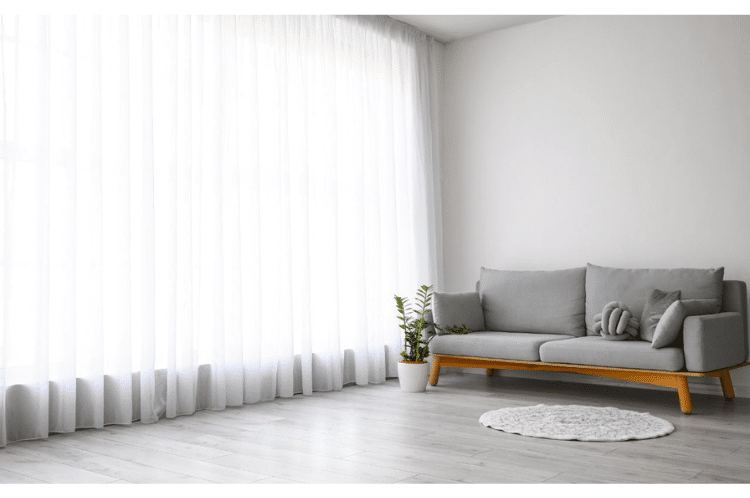
Step out to the footpath at dusk while someone switches on the living-room lights. A sheer that screened the room all day can reveal a surprising amount once the light is behind it.
Picture a living room facing a footpath. During the day you may want to see the garden without watching every passer-by. After dark, you may want to turn on the lights and stop people looking in. Those are two different lighting conditions, so the same fabric may not provide the same privacy in both. For a room-by-room version of this decision, see how to balance daylight and privacy.
Compare the three jobs a fabric can do
Sunscreen or mesh fabrics admit daylight and can preserve some view through the weave. The degree of visibility varies with the fabric, the angle and the relative brightness on each side. At night, a lit room can become visible from outside. A sunscreen alone is therefore a poor assumption for reliable evening privacy.
Light-filtering fabrics generally diffuse light and obscure the view more than an open mesh, but the result varies. Shadows or silhouettes may still be visible when a room is lit. If privacy is important, test the actual sample rather than assuming that “translucent” means invisible.
Blockout fabrics stop light passing through the fabric itself. The installed blind can still admit light or allow views at its edges, depending on the design and fit. It also removes the view when lowered. Ask about the trade-off between the coverage you want and the mounting space available.
Test a sample at the right time
Hold the sample at the window in daylight and look through it from both sides. Then repeat after dark with the room lit as it normally would be. Consider the actual viewing position: a nearby path, an elevated neighbouring window and a distant street can produce different sightlines. A small swatch is useful for comparison, but it cannot perfectly reproduce a finished blind and its edge gaps.
Ask who will use the room and when. A dining room may need daylight most of the day and privacy only in the evening. A bedroom may put privacy and a darker room ahead of an outside view. You do not need to make every window identical if the rooms do different jobs.
One layer or two?
A single light-filtering or blockout blind can be simpler where its compromises suit the room. A dual arrangement can pair a more open daytime fabric with a more opaque evening fabric. It also adds hardware, another surface to maintain and an extra decision about where the blind fits. Ask to see the proposed brackets and how the layers will be operated. For doors or shallow recesses, check clearance before choosing.
In Shepparton, Bush’s Blinds lists both rollers and custom sheers. Ask to see the fabrics together, ideally with light behind them.